
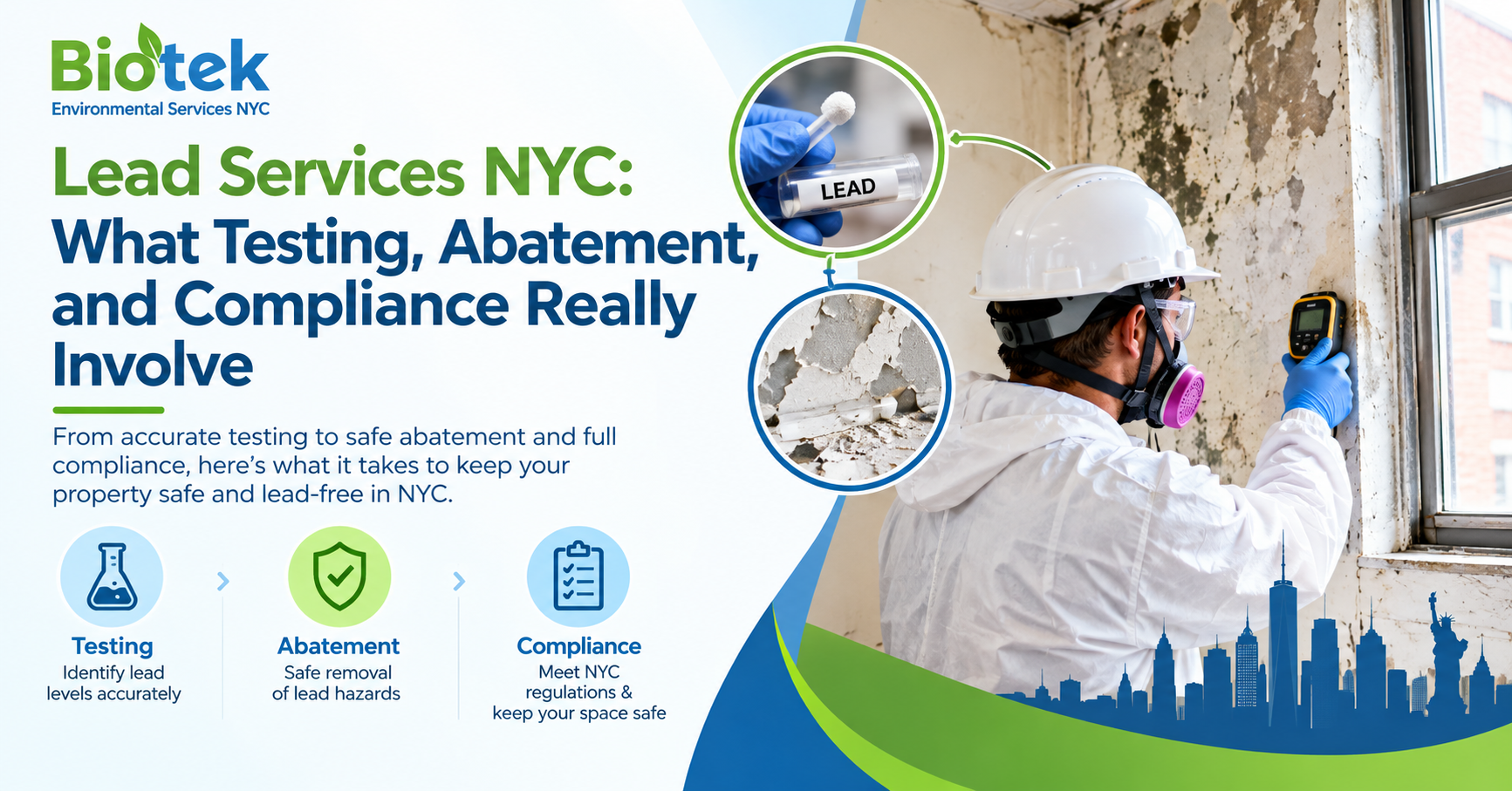
A tenant mentions a new baby. An HPD inspector flags peeling paint on a window sill. A buyer’s attorney asks for your XRF report. Any one of these can turn lead from a background worry into a deadline, and most owners who start searching for lead services NYC contractors at that point aren’t sure what they’re actually buying.
The work comes down to three jobs. First, find out where lead is and whether it’s a hazard. Next, remove or control it safely. Then document everything so HPD, your board, or a lender can see the building is compliant. This guide walks through each step, what the city expects, and where owners lose the most time and money.
Why a 1950s Paint Job Is Still Your Problem Today?
New York City banned lead-based paint in homes in 1960, but the paint didn’t go anywhere. It sits under newer coats on window frames, door jambs, baseboards, and stair rails in pre-war buildings across all five boroughs.
Local Law 1 of 2004 treats that paint as a hazard until proven otherwise. If your building went up before 1960 and has three or more apartments, the city presumes lead paint is present in any unit where a child under six lives. The same rule covers buildings from 1960 to 1978 when the owner knows lead paint is there. That presumption triggers annual notices to tenants, yearly visual investigations, and fast repairs whenever paint starts to fail. It’s also where most requests for lead services in NYC begin.
The bar is also lower than many owners remember. Since December 2021, the city has defined lead-based paint as anything testing at 0.5 milligrams per square centimeter or higher, half the old federal level. Peeling paint above that line is a Class C, immediately hazardous violation. That’s why every decision should rest on hard data, not guesses about what a previous owner painted over.
XRF Readings, Dust Wipes, and the Deadline That Already Passed
Two tools do most of the detective work. An XRF analyzer is a handheld device that reads lead content through layers of paint without scraping or damaging the surface. Dust wipe samples go to a lab and show whether lead is already sitting on floors and window sills, where small hands pick it up.
Under Local Law 31, owners of pre-1960 rental buildings had until August 9, 2025, to complete XRF lead paint testing in every apartment. Local Law 111 extended the same requirement to hallways, lobbies, and stairwells. Owner-occupied co-op and condo units are exempt, but a unit becomes subject to the rules once it’s sublet. If your building missed the deadline, it’s out of compliance right now, and scheduling the testing yourself beats waiting for a violation to force it.
A clean result has real value. If a unit or common area tests free of lead paint, you can apply to HPD for an exemption, which can remove annual notice and investigation duties for that space. Keep every report. The city expects owners to hold lead records for at least ten years.
Inspection or Risk Assessment? Know Which One You’re Ordering
These two terms get swapped constantly, and the mix-up wastes time. A lead inspection is a surface-by-surface survey that answers one question: does this painted component contain lead, and at what level? It’s the right choice before a sale, for an exemption application, or to meet the XRF mandate.
A risk assessment goes further. It looks at the condition of the paint, measures lead in dust and sometimes soil, and ranks which problems need attention first. If a young child already lives in the unit, or paint is visibly breaking down, a risk assessment gives you a work plan instead of a list of readings.
Lead Abatement or Interim Controls: Picking a Fix That Lasts
Once you know where the hazards are, there are two broad ways to deal with them. Interim controls, such as stabilizing loose paint and repainting, reduce the risk for now. They cost less upfront, but they need regular monitoring, and the problem returns the moment the paint fails again.
Lead abatement is permanent. It means stripping the paint, replacing the component outright, or sealing it behind an enclosure or approved encapsulant. Old window sashes are the classic example. Every time they open and close, friction grinds painted surfaces into fine dust. Replacing them solves the problem at its source, and it matters at apartment turnover, when Local Law 1 requires owners to make door and window friction surfaces lead-safe before a new tenant moves in.
The right choice depends on the building, the budget, and how long you plan to own it. Abating the worst components once can cost less over time than repainting the same sills every year.
What Happens Behind the Plastic Sheeting?
Good lead work is slow on purpose. Before any surface is disturbed, the crew seals the area with plastic sheeting, closes vents, and sets up negative air pressure so dust stays inside the work zone. Scraping is done wet. Power sanding happens only with HEPA-attached tools, and dry sanding or open-flame burning is off the table.
Federal law backs this up. The EPA’s Renovation, Repair and Painting Rule requires firms that disturb paint in pre-1978 homes to be EPA-certified and to have a certified renovator on the job. New York City adds its own work-practice and notification rules for larger projects in buildings where young children live.
The job isn’t finished when the walls look clean. After HEPA vacuuming and wet wiping every surface, an independent technician collects dust wipe samples. Only a passing clearance result shows the space is safe to reoccupy, and it’s the first document HPD and co-op boards ask to see.
Lead Services in NYC That Hold Up When Someone Checks the File
Plenty of contractors can scrape and repaint. Fewer can hand you a paper trail that satisfies an HPD inspector, a co-op board, and an insurer at the same time. Biotek NYC treats documentation as part of the work itself: test results, containment records, cleanup logs, and an independent clearance report for every area touched.
Older buildings rarely have just one problem, either. Water that gets behind painted trim loosens paint faster than normal wear, so lead hazards and moisture damage tend to show up in the same rooms. Because the same team also handles mold remediation and HPD violation repairs, both issues can be planned together. Walls get opened once, and containment goes up once.
Before the Next Annual Notice Goes Out
Lead compliance doesn’t get easier with time. Paint keeps aging, tenants change, and the city keeps tightening its standards. The owners who handle it best test early, fix the hazards that matter most, and keep their records ready before anyone asks.
If your building dates from before 1960, or you’re unsure what your last XRF report actually covered, talk to Biotek NYC about lead services NYC property owners can rely on, from first test to final clearance. Request a free quote or call +1 (212) 784-6490 to book an assessment.
FAQs
A full job covers XRF testing, dust wipe sampling, a risk assessment, containment, lead abatement or interim controls, specialized cleanup, and an independent clearance test. You also receive the reports and affidavits HPD can request from owners at any time.
Yes, if it’s a pre-1960 rental building. Local Law 31 required XRF lead paint testing in every unit and common area by August 9, 2025, regardless of who lives there. Owner-occupied co-op and condo units are the main exception.
Small jobs, like replacing a few window components, can finish in a day or two. Larger, multi-room projects run a week or longer. Clearance testing adds time, because lab results must come back before residents return to the space.
Only an EPA-certified lead inspector or risk assessor can carry out XRF testing that counts toward Local Law 31. Ask for a signed report and affidavit, and keep both with your building’s lead records for at least ten years.
HPD issues a Class C, immediately hazardous violation with a short correction deadline. Repairs must follow lead-safe work practices, backed by clearance dust wipe results. Open violations bring penalties and can hold up a refinancing or a building sale.
 CALL US
 CONTACT US