
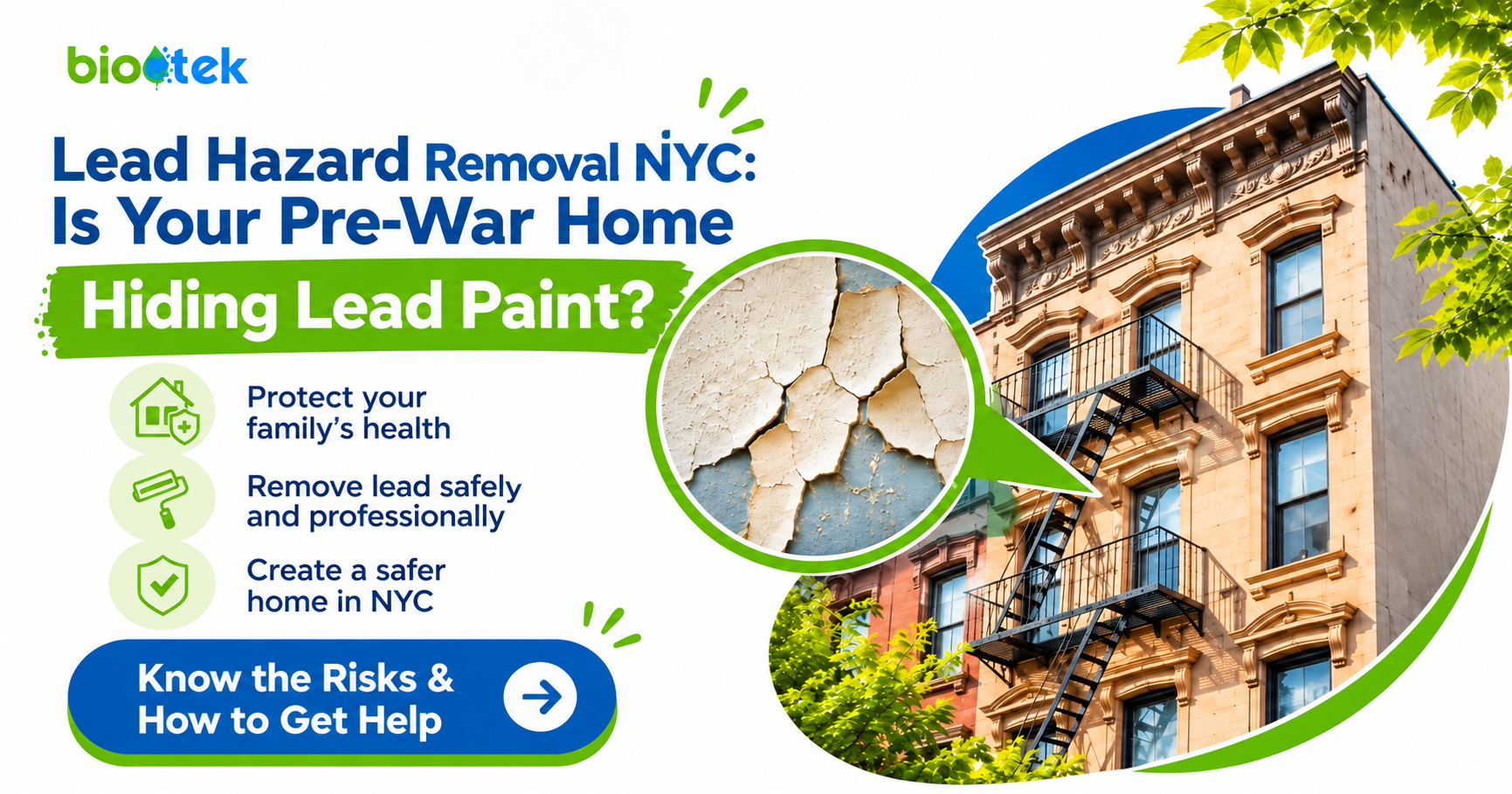
Most people searching for Lead Hazard Removal NYC advice have just noticed something. A flaking windowsill. A toddler crawling near an old radiator. A renovation quote that mentions lead.
New York’s pre-war homes sell on charm, with high ceilings, plaster walls and original moldings. But under decades of fresh coats, many of those surfaces still carry paint made with lead. Most of the time, it sits there quietly. The trouble starts when that paint cracks, peels or gets sanded, because that’s when it turns into dust you can’t see.
This guide covers where lead hides in older homes, what the city expects from owners, and when professional help makes sense. If you rent, own or manage an older building, you’ll know what to look for by the end.
Why Pre-War Walls Keep Their Secrets?
New York City banned lead in residential paint in 1960, and the federal ban followed in 1978. A huge share of the city’s housing went up long before either date. That’s why Lead Hazard Removal NYC remains a live issue in brownstones, walk-ups and pre-war co-ops across all five boroughs.
Painting over old layers doesn’t remove the lead. It just buries it. The original paint stays bonded to the plaster, trim and window sashes underneath.
Lead turns into a hazard in three common ways:
- Deterioration: Paint peels or flakes because of leaks, steam heat or age.
- Friction: Windows and doors rub against painted frames and grind paint into fine dust every time they move.
- Disturbance: Sanding, scraping, drilling or demolition releases particles into the air.
That last one surprises people. A weekend project to strip an old door frame can create more dust in an afternoon than years of slow chipping. Young children face the greatest risk, since they touch floors and windowsills and then put their hands in their mouths.
What the City Expects From Owners of Older Buildings?
New York doesn’t wait for owners to prove lead exists. Under Local Law 1 of 2004, owners of pre-1960 buildings with three or more apartments must presume that all paint contains lead, according to the NYC Department of Housing Preservation and Development (HPD). The same applies to tenant-occupied units in one and two-family homes built before 1960. Buildings from 1960 to 1978 are covered too if the owner knows lead paint is present.
That presumption comes with real duties. Owners must send an annual notice to find out whether a child under six lives in each unit. They have to inspect those units every year, fix peeling paint along with the defects causing it, and make apartments safe before a new tenant moves in.
Skipping these steps gets expensive. HPD can issue violations, and when owners don’t act, the agency can send its own contractors to make repairs and bill the owner for the work.
Lead Paint Testing Comes Before Any Repair
You can’t fix what you haven’t measured. Local Law 31 of 2020 required owners to complete lead paint testing with X-ray fluorescence (XRF) analyzers in every rental unit of covered buildings. Later laws added common areas such as hallways and lobbies. HPD’s January 2026 lead bulletin for property owners confirms that the August 9, 2025 deadline has passed, so buildings without records are already behind.
An XRF analyzer reads lead levels through layers of paint without damaging the wall. It shows which surfaces contain lead and which don’t, so removal work goes exactly where it’s needed.
One rule catches many owners off guard. HPD’s Local Law 31 FAQ states that the inspector can’t be the owner, the owner’s agent or a contractor involved in the remediation. Testing and removal belong with separate parties, and that separation keeps the results honest.
The Moisture Problem Hiding Behind Peeling Paint
Peeling paint is rarely random. In older New York buildings, water is usually behind it. Think of a slow leak inside a bathroom wall, a dripping radiator valve, or condensation around single-pane windows.
This is where lead and mold overlap. The same moisture that feeds mold growth also loosens paint from plaster. City rules recognize this, which is why owners must repair the underlying defect and not just the paint. Scrape and repaint a damp wall, and the flaking returns within months.
For a team that deals with water damage and mold every day, this overlap is familiar ground. Biotek NYC looks at the source of the moisture and the condition of the paint together, so you’re not paying to solve the same wall twice.
Lead Hazard Removal NYC: What a Proper Job Looks Like
Removing lead safely is less about the scraping and more about everything around it. Any paid work that disturbs paint in a pre-1978 home falls under the EPA’s Renovation, Repair and Painting Rule, which requires certified firms and trained workers. A proper lead-safe renovation follows a clear order, and each stage protects the next one:
- Containment: Plastic sheeting seals off the work area, and vents are covered so dust can’t drift into other rooms.
- Wet methods: Surfaces are misted before scraping to keep particles out of the air. Open-flame burning and high-speed sanding without HEPA capture are prohibited.
- Removal or encapsulation: Depending on the surface, crews strip the paint, replace parts like old window sashes, or seal the paint under an approved coating.
- Cleanup: HEPA vacuums and repeated wet wiping pick up what’s left.
- Clearance: An independent party collects dust wipe samples and sends them to a lab before anyone moves back in.
Skip a step and the whole job suffers. Poor containment makes cleanup harder, and rushed cleanup fails clearance, which means paying for the same work twice.
The New, Tougher Standard for Lead Dust
For years, federal rules set fixed numbers for how much lead dust on floors and windowsills counted as a hazard. That changed in late 2024. The EPA’s final rule published in the Federal Register lowered the dust-lead hazard standard to any reportable level of lead found by an accredited laboratory.
In plain terms, the margin for error has shrunk. Risk assessors now flag lead dust at amounts that once passed without comment. Lead dust cleanup has to be thorough enough to satisfy a lab, not just look clean to the eye. A quick sweep and a mop won’t get you there, and dry sweeping can push fine particles back into the air.
This is also why DIY cleanup after a renovation is risky. Household vacuums without HEPA filters blow the smallest particles straight back into the room.
Before You Pick Up That Paint Scraper
Old paint alone isn’t a reason to panic. It is a reason to act in the right order. Confirm what’s on your walls through independent testing, fix the moisture behind any peeling, and leave the removal to trained professionals who work under containment.
If your pre-war home has flaking paint, water damage or a renovation on the calendar, talk to Biotek NYC about Lead Hazard Removal work planned around your building, your family and the city’s rules. Reach out through our website today, and we’ll talk through what your space actually needs.
Questions NYC Homeowners Ask About Lead Paint
Not every one, but city law treats paint in covered buildings built before 1960 as lead-based unless testing proves otherwise. Many pre-war apartments in NYC still have original layers under newer paint, especially on windows, doors, trim, stair railings and radiators.
Home kits can hint at lead, but they don’t meet NYC compliance rules. Legal lead paint testing requires an EPA-certified inspector or risk assessor using an XRF analyzer, and that inspector must be independent of the owner and removal contractor.
It depends on the size of the area and the method used. A few windowsills take far less time than a full apartment turnover. Clearance testing also adds time, since dust wipe samples have to go to a lab first.
Not inside the work area itself. Children and pregnant people should stay away until clearance testing confirms the space is safe. For larger jobs, your contractor should tell you whether temporary relocation makes sense while containment is in place.
Report it to your landlord in writing first. If a child under six lives with you and nothing changes, call 311 to file a complaint with HPD. Don’t scrape or sweep the chips yourself, since that spreads fine dust around your home.
 CALL US
 CONTACT US